Serious Play Storage

A 2×2 LEGO brick that opens up and holds an entire Serious Play set inside. Built as a better home for the sets a facilitator hands out at the start of every session, one that survives being thrown in a car and feels like part of the session itself. Stackable, and printed in primary colours.

00

The Brief

Canvas Concepting runs LEGO Serious Play sessions, and every participant gets the same small set to build with. Those sets were living in ziplock bags, functional, but the first thing everyone touched at the start of a session looked like packaging waste. The ask was simple: something that holds the set, survives being thrown in a car, and feels like part of the session instead of a leftover from the shop.

The Outcome

Ten FDM-printed containers, each one a scaled-up 2×2 LEGO brick with a lid that pulls off the top. Studs on top, recesses underneath, so the containers stack into towers exactly like the real thing. Printed in the basic primary colours, picked together with the client to keep it simple. In use at sessions now, with each set permanently stored in its own brick. No more sorting, no more bagging.

The Process
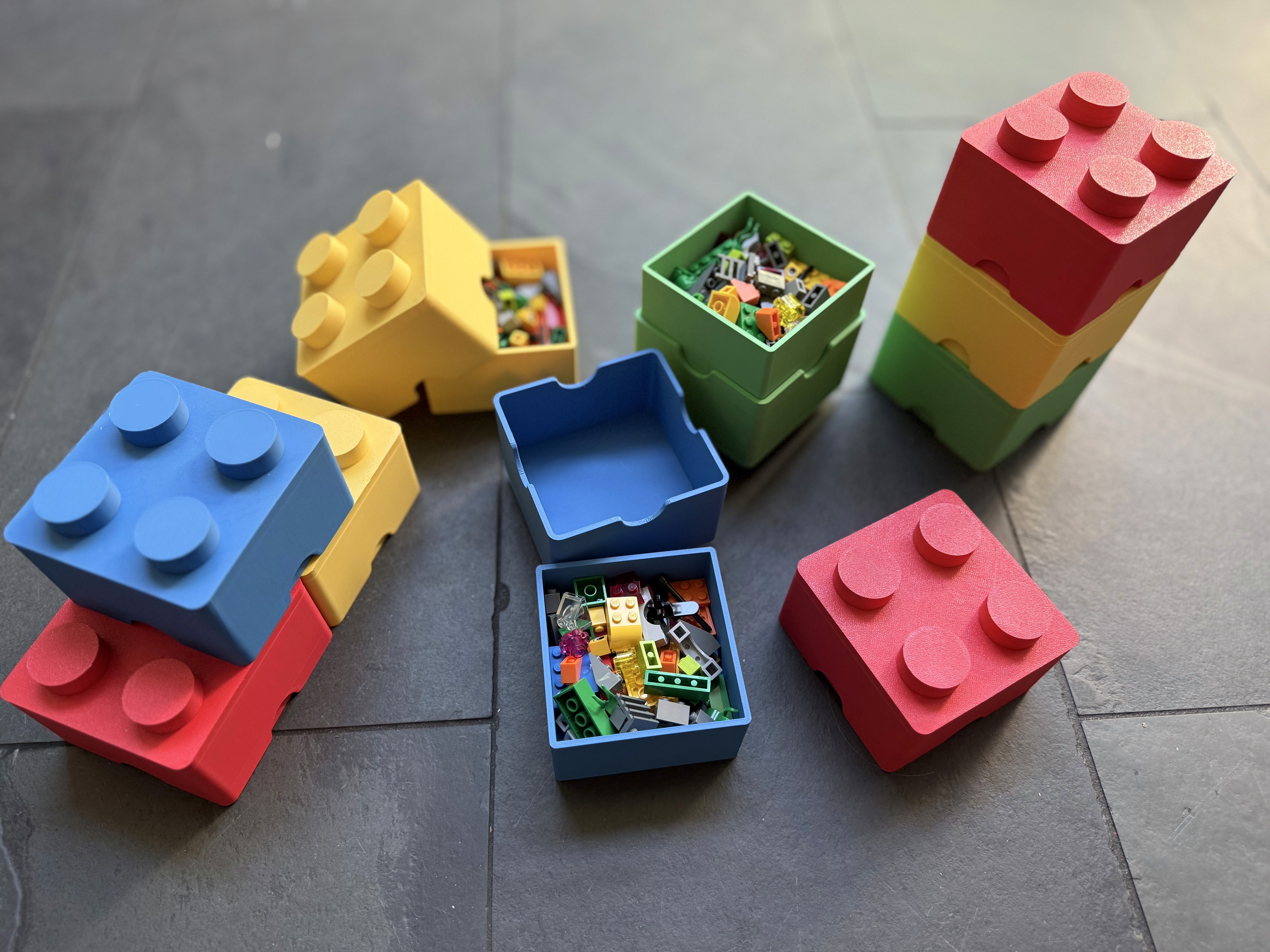
From a measured LEGO brick to ten stackable containers in a week, one parametric model, a bit of tolerance chasing, and a lid that had to feel exactly right.

It started with a real LEGO brick and a set of calipers. Every dimension went into Fusion 360 as a parametric model, so the whole thing could be driven from one scale value, not just the outer shell, but wall thickness, stud size, and the recesses underneath. That was the fiddly part: scale a brick to 200% and the fit stops working unless the internal geometry scales on its own terms. Getting that math right meant the final size could stay an open question until the end.

The first print was deliberately small, a look-and-printability test, far too small to hold anything. From there it was a matter of scaling up until the set fit inside and the brick still felt right in the hand. Not too big, not too small. Then the stacking: the underside needed proper recesses for the studs to seat into. First fit was too loose and a stacked tower came apart the moment it was picked up. One tolerance adjustment fixed it.

The lid took the real attention. Too loose and the brick falls open when you lift it; too tight and opening it becomes a chore. It landed somewhere better than either, lift the top and the air inside slows it down, so the lid separates gently over a few seconds. Like opening an iPhone box. Small cutouts at the bottom edge let you grab the base and speed things up when twenty seconds of suspense is too much. Two prints total to get there.

From a measured LEGO brick to ten stackable containers in a week, one parametric model, a bit of tolerance chasing, and a lid that had to feel exactly right.

It started with a real LEGO brick and a set of calipers. Every dimension went into Fusion 360 as a parametric model, so the whole thing could be driven from one scale value, not just the outer shell, but wall thickness, stud size, and the recesses underneath. That was the fiddly part: scale a brick to 200% and the fit stops working unless the internal geometry scales on its own terms. Getting that math right meant the final size could stay an open question until the end.

The first print was deliberately small, a look-and-printability test, far too small to hold anything. From there it was a matter of scaling up until the set fit inside and the brick still felt right in the hand. Not too big, not too small. Then the stacking: the underside needed proper recesses for the studs to seat into. First fit was too loose and a stacked tower came apart the moment it was picked up. One tolerance adjustment fixed it.

The lid took the real attention. Too loose and the brick falls open when you lift it; too tight and opening it becomes a chore. It landed somewhere better than either, lift the top and the air inside slows it down, so the lid separates gently over a few seconds. Like opening an iPhone box. Small cutouts at the bottom edge let you grab the base and speed things up when twenty seconds of suspense is too much. Two prints total to get there.

year

2025

timeframe

7 Days

tools

Fusion 360 · FDM

category

B2B

01

In use during a session

02

The bricks handed out and being built from

.say hello

I'm open for freelance projects, feel free to email me to see how can we collaborate

.say hello

I'm open for freelance projects, feel free to email me to see how can we collaborate

© 2026 The Micro Company · Breda, NL · All rights reserved.